It’s goodbye Calvin and Tommy and hello Marc for G-III Apparel Group.
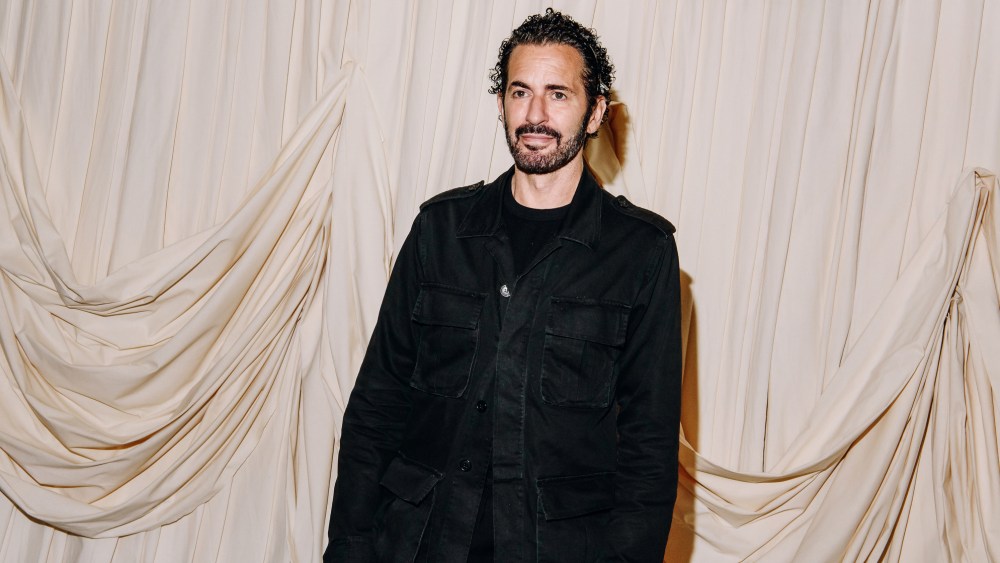
The Seventh Avenue mainstay — which topped first-quarter earnings expectations and raised its outlook for the year — is transitioning out of most of its licensed Calvin Klein and Tommy Hilfiger business this year and slotting in Marc Jacobs, which it is buying from LVMH Moët Hennessy Louis Vuitton with WHP Global.
Morris Goldfarb, chairman and chief executive officer, called the Marc Jacobs deal an “awesome acquisition” that was a few years in the making.
You May Also Like
Related Articles
“We identified it two years ago and it took time for LVMH to be motivated enough to make the transaction happen,” Goldfarb told WWD. “Many nuances, but WHP negotiated the deal originally, brought us into it and we share a 50 percent equity stake in the IP and we have all the operating responsibility.”
Both G-III and WHP are putting $425 million into the joint venture buying the brand and G-III is spending roughly another $75 million to buy the operating business.
“Contrary to most IP situations where a brand is bought to drive volume regardless of distribution, this one has got guardrails that are put up by us and agreed upon with WHP,” Goldfarb said. “They’re good partners. They see it the same way we do. And the brand is being built and slightly adjusted for long-term value.
“We’re not looking to make a cash cow out of it Day One,” he said. “There won’t be channel change dramatically. They’ve done some wonderful things. Marc Jacobs, the brand, is clearly iconic. He is one of the most influential designers in modern American fashion. If there’s not a day, you don’t see a good story, a good fashion, fun story that relates to Marc.
“We’re acquiring the brand because of its cultural relevance and the creative authority that’s been created,” Goldfarb said. “We’re not here to really change the brand. It has an awful lot of growth potential. The beauty of this is, as we collaborate with the existing manager, we’re aligned. They agree with where we plan on taking it — and where we’re going to take it in some form is very much our sweet spot. We have the expertise to build the brand in this segment that we care to build. We’re not a producer that’s targeted at a Walmart or a Target or for that matter at Kohl’s. We touch all those distribution channels, but it’s not our core competency. Our core competency, the department store sector, we do well there. We’re respected there.”

G-III and WHP have both been careful to communicate to the market that they know what they have with Marc Jacobs and will be good stewards of the business, where the designer is going to stay on as creative director.
“Marc is … exactly where he was before,” Goldfarb said. “The runway shows are going to continue to be developed and funded. Nothing is necessarily forever. We’re going to give it a shot. We believe there’s an essential need for the halo aspect of this brand. And we’re happy to fund it. It is maybe more of a marketing component. We’re not going to produce $5,000 handbags. That’s not where the brand is.
“Marc is positioned at, call it volume luxury and we’re going to continue with that,” the CEO said. “And he’s known for his runway shows. It’s part of what he’s built. He built it in his own brand. He did a great job at Louis Vuitton. People look forward to those shows. We see this as a tool toward enabling the intellectual property to go out and be licensed at a different level than historically” it has been.
Goldfarb said the designer’s next show, for spring, will be a continuation of the old regime and that G-III can get more involved for the fall collection next year.
“Our fingerprints are not going to be dramatic, [but] change will be much more obvious for fall of next year,” he said.
While Marc Jacobs continues to zero in on the runway, Goldfarb is going to be taking a hard look at the brand’s Heaven diffusion business as well as the discontinued Marc by Marc.
“We’re good at creating diffusions and there will be a diffusion brand of Marc Jacobs,” the CEO said. “They’ve had some distribution in two diffusion brands. We will choose one of them and go forward with distributing it to, not the luxury sector. Luxury will remain in place and the changes will be more on a diffusion level. I don’t want to speak for LVMH chief Bernard Arnault and the organization, but it doesn’t appear that they wanted to go [that direction] with the brand, or any brand for that matter. We are maybe a little less purist than LVMH. Maybe our competencies are a little different than theirs and we’re going to take advantage of the many decades of experience.”
Goldfarb, who’s been CEO of G-III for 52 years, remains on the cutting edge, in fashion and business.
Asked if he had more deals in the works, Goldfarb snapped back quickly, saying: “More to come. I’m still a young guy. In most people’s world, I would tell you, they would say there’s a ton going on this week. And in our world, it’s a normal day. It’s a normal week. We always look at situations. We would be foolish not to pay attention to what surrounds us.”
Already, Goldfarb has been busy working to fill the hole that’s been left as the Tommy Hilfiger and Calvin Klein licenses revert back to PVH Corp. That’s included the Donna Karan relaunch, a big marketing push with Hailey Bieber at DKNY and more at the company’s other businesses, from Karl Lagerfeld to Vilebrequin and a host of licensed businesses, including Converse and Starter.
G-III’s first-quarter net income shot up to $66.5 million from $7.8 million a year earlier as the company logged $102.7 million in pre-tax tariff refunds. On an adjusted basis, setting the tariff refunds aside, losses per share tallied 21 cents, down from earnings of 19 cents a year ago, but still 9 cents ahead of the 30-cent deficit analysts figured on, according to Yahoo Finance.
Sales for the quarter ended April 30 fell 8 percent to $536 million, better than the 9.2 percent decline expected amid the licensing switch.
For the full year, sales are expected to fall by 8.4 percent to $2.71 billion, incorporating a loss of about $470 million in sales tied to Calvin Klein and Tommy Hilfiger.
Adjusted earnings per share are now slated for $2.15 to $2.25, ahead of the $2 to $2.10 projected in March and the $2.09 analysts figured.