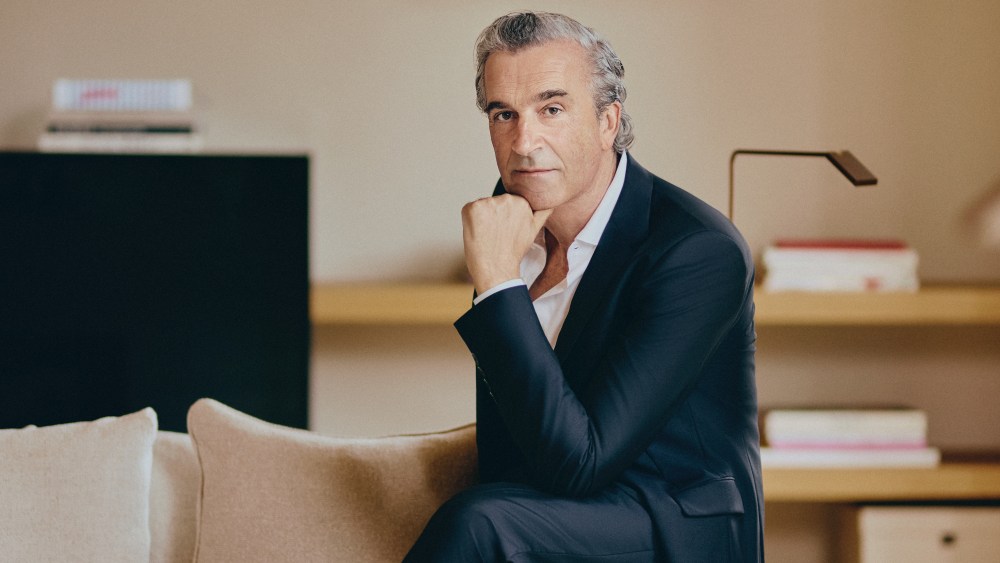
PARIS — José Manuel Albesa sees his tenure as Puig‘s new chief executive officer as more of an evolution than a revolution. After all, he has worked with Marc Puig, the group’s former CEO who is now its executive chairman, for the last 22 years.
“We share a very similar strategic approach and the same passion for our culture and our values,” Albesa said, explaining his aim is to continue building on what they constructed, “the way we built on our purpose of becoming a home of ‘love brands’ in a family company, our position of a home of creativity and our values.”
Related Articles
And it’s an exciting time to lead Puig — not least given how eager the industry is to see what’s next for the group following the collapse of talks with the Estée Lauder Cos. about a possible merger. While Albesa did not address anything about the discussions, he highlighted Puig’s strengths as a stand-alone entity.
“We are a strong, independent company, confident in our own path with powerful brands, a winning team and a solid balance sheet behind us,” Albesa said, speaking on Monday after having presented at the company’s annual general meeting for the first time on May 29, and echoing some of the statements Marc Puig made at the AGM.
Organizing his priorities into three sections, Albesa said the first is: “focus.”
“My job is to make Puig sharper, more agile and more integrated as we move into our next phase,” he said. “A big part of that is the way we are reorganizing.”
The group is evolving from a more divisional structure, which has some silos and overlaps, toward an integrated company built on the pillars of global brands, global markets and global functions.
“The logic is simple: Our brands keep their creative autonomy, while we gain the scale, speed and agility of one company,” Albesa said. “[This allows for] less complexity, fewer duplications and more focus on what truly matters — developing our brands and our consumer-centric approach and its strategies.”
Meanwhile, he plans to bring more audacity to Puig, which Albesa describes as entrepreneurial in approach.
His second focus is on executing the group’s growth agenda. Over the past five years the company has been growing at 18 percent CAGR, faster than its competitors.
“This passion for growth continues,” Albesa said. “And it’s really important.”
Puig’s next strategic plan will be unveiled during its first capital markets day, scheduled for Oct. 28.
“What I can tell you now is that we will keep scaling the parts of the business that are already performing strongly,” Albesa said.
That includes developing Puig’s three-axis brands, such as Carolina Herrera and Charlotte Tilbury; reinforcing its leadership in niche, which year-to-date has been posting high-double-digit gains; continuing to revolutionize prestige perfumery with Rabanne and Jean Paul Gaultier, and positioning derma — with Uriage and Apivita — as a new pillar of growth, according to Albesa. He said Puig’s derma activity has been outpacing the market over the past few years.
“We will continue building our leader markets like EMEA, travel retail and Latam,” Albesa explained. In the U.S., the company has doubled its penetration over the past four years.
“So we are very happy,” Albesa said. Puig is poised to take an important step into Asia, with different strategies in place for Northeast and Southeast Asia.
Already, the group is growing fast in Asia. In the first quarter of 2026, sales there increased 26.1 percent in like-for-like terms, which follows on from two prior quarters of strong gains.
Albesa’s third focus is discipline. “We are committed to delivering sustainable, profitable growth, to keep investing in our brands and to preserve the flexibility to pursue the selective opportunities that genuinely fit Puig,” Albesa explained.
As previously reported, at the AGM, Marc Puig said of the talks with Lauder, which ended on May 21: “We made it clear, as we are not for sale, the combination that was being explored would have required alignment on three key aspects for the potential merger: governance, business leadership and economic terms that would appropriately value the company and be fair to all stakeholders.”
Albesa said during the recent interview that Puig is highly disciplined about M&A, and that any target must be a love brand — defined as having a unique vantage point, strong DNA and cultural relevance — as was the case with the likes of Dries Van Noten, Jean Paul Gaultier, Charlotte Tilbury, Byredo and Dr. Barbara Sturm.

Nonetheless, it is clear that scale matters. “We are conscious of the need today of scale and its importance,” Albesa said. “But we will continue with our approach.”
He added: “We have always taken a highly selective, value-driven approach to M&A and to brand-building, and we will keep exploring options that present a clear strategic fit with our portfolio, always with capital discipline.”
The definition of “scale” has changed. As in the past it means size — but not only.
“It is about having the capabilities, the global reach and the operational platform to support brands and compete across categories and geographies,” Albesa said. “One of Puig’s real strengths is exactly this: the ability to combine the agility and creativity of an entrepreneurial brand with the scale of a global platform, preserving brand desirability and autonomy, while drawing on shared capabilities in product development, digital, retail and go-to-market.”
Such scaling is being accelerated.
The company keeps seeing premium beauty as a highly attractive consumer segment that is driven by a worldwide population, including from emerging markets, with a healthy appetite for innovation, self care and longevity. This comes as the consumer lifecycle in the category is getting longer — by about 20 years or more.
Within premium beauty, Puig anticipates fragrance will remain the most dynamic category, especially with growth in China — which is back since the last three quarters — and other countries in the Asia-Pacific region. Albesa noted huge potential in America as well as in the Middle East, once the Iran war is resolved.
He expects fragrance’s dynamism will be “supported by the premiumization of the category and by discovery through digital channels. Puig has benefited strongly from this, and our niche portfolio continues to grow at double digits.”
Still, Albesa said that after numerous years of strong gains, the group senses the fragrance market is normalizing toward more historical levels.
“We also see brands turning to different growth strategies, such as promotions, price offers, heavy discounting,” Albesa said. “We will not play that game. We will lean on the strength of our brands and outperform through innovation.”
He underlined consumers remain engaged with brands that can create desirability, emotional connection and genuine cultural relevance.
Although precise predictions are difficult to make, Albesa said in the first quarter of this year the prestige fragrance market grew by about 3.5 percent on a like-for-like basis.
“We will see the impact of the Middle East situation in the coming months,” Albesa said. “Makeup is growing at low-to-midsingle digits and remains highly attractive, while skin care is showing midsingle-digit growth, with derma gaining relevance as consumers increasingly look for efficacy and innovation.”
Prestige beauty has become far more global.
“Growth today is more diversified across regions and channels, with strong momentum in markets such as the U.S. and parts of Asia, and digital continues to reshape how consumers discover, engage with and buy brands,” Albesa said.
“We believe the companies that will keep outperforming are those that combine creativity with disciplined execution — protecting strong brand equity and desirability, while scaling globally through operational excellence and shared capabilities,” he added. “That has always been the Puig way.”
Albesa said: “It’s a great moment for us. We have huge opportunities in the future.”